Fast, Easy, and Scientifically Trusted TEWL Meter
VapoMeter® VX
VapoMeter® VX is Delfin’s latest generation of portable TEWL meters, offering effortless operation and scientifically proven accuracy - now with a smart, ergonomic design and intelligent features that make skin barrier research more efficient than ever.

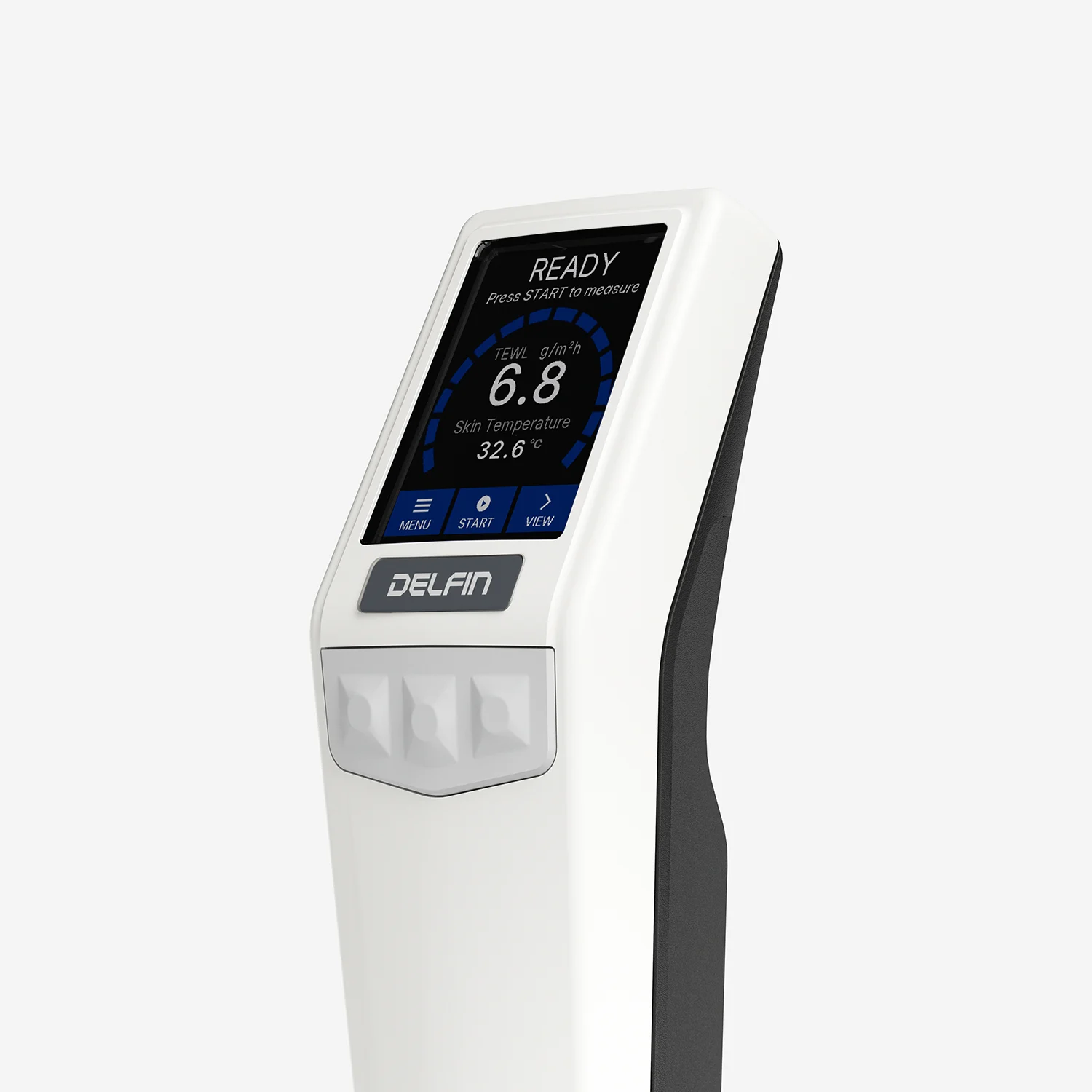
VapoMeter® (VX) - TEWL. Smart simplicity. Reliable science. Closed-Chamber.
Transepidermal water loss (TEWL) is a key indicator of skin barrier function, and accurate measurement is essential for both clinical research and personal care applications. Powered by Delfin’s validated closed-chamber technology, the VapoMeter® VX delivers fast and repeatable TEWL measurements, making it ideal for both laboratory and on-site testing.
Due to its closed-chamber measurement principle, VapoMeter® VX measurements are not affected by ambient airflows or device orientation, enabling reliable readings within seconds. With improved usability and a user-replaceable calibrated sensor, the VapoMeter® VX also includes a built-in skin temperature sensor. Recording the skin temperature with each TEWL measurement helps users interpret and analyze results more effectively. Diffusion cell adapters will soon be available, enabling the device to support in vitro measurements.
Designed for science - keeping the user in mind
From R&D labs to clinical trials, VapoMeter® VX is built for professionals who value simplicity, and science in one device. Whether you're testing cosmetic formulations, studying skin barrier recovery, developing topical treatments, or conducting in vitro assessments, VapoMeter® VX helps streamline your work while ensuring data quality. It's the perfect balance of scientific performance and modern usability. Experience the new standard in TEWL testing. Get quote on VapoMeter ® VX.

Benefits
- Closed-chamber measurement principle
- Smart ergonomic design with high-resolution display
- Fast measurement process
- User-replaceable calibrated sensor (no shipping for calibration)
- Built-in skin temperature measurement
- Remote software updates
- Bluetooth & Wi-Fi Connectivity
- Intelligent on-screen guidance
- Sensor check procedure
- ESG-friendly, reusable design
Educational materials
Educational materials
Ready to turn measurement into meaningful insight?
Discover how Delfin’s measurement technologies can support your research and clinical work.

FAQs
FAQs
Transepidermal water loss (TEWL) is the amount of water that passively evaporates through the skin and is widely recognized as one of the most important indicators of skin barrier function. Elevated TEWL values may indicate impaired barrier integrity and are commonly associated with conditions such as eczema, psoriasis, irritant dermatitis, and damaged skin. TEWL measurements provide objective data for dermatological research, cosmetic efficacy testing, pharmaceutical studies, and skin barrier assessment.
Working on skin hydration measurements instead of TEWL? See Delfin's skin hydration testing devices.
VapoMeter® VX measures transepidermal water loss (TEWL) using Delfin’s validated closed-chamber technology. During the measurement, a sealed chamber is placed on the skin surface, allowing water vapor evaporating from the skin to accumulate inside the chamber. A highly sensitive humidity sensor detects the resulting change in humidity over time, and the TEWL value is calculated from this change.
The closed-chamber method is well established in the scientific literature and widely recognized as a reliable approach for TEWL assessment. By minimizing the influence of ambient airflow and allowing measurements to be performed independently of device orientation, VapoMeter® VX provides fast, objective, and repeatable skin barrier measurements in both research and clinical settings.
VapoMeter® VX uses Delfin's validated closed-chamber technology, a well-established and widely recognized method for TEWL measurement in scientific research. During the measurement, water vapor evaporating from the skin accumulates inside a sealed chamber, where the TEWL value is determined from the humidity change.
The closed-chamber principle makes TEWL measurements practical and convenient because ambient airflows, such as breathing, ventilation, air conditioning, or opening doors, do not interfere with the measurement. The method is also independent of measurement orientation, allowing reliable measurements on both horizontal and non-horizontal skin sites. Combined with a fast measurement time of typically 7–12 seconds, these features make VapoMeter® VX well suited for dermatological research, cosmetic testing, clinical studies, and field measurements.
Ambient temperature, relative humidity, and airflow can influence skin barrier measurement values and their interpretation. While VapoMeter® VX minimizes the impact of airflow through its closed-chamber design, documenting environmental conditions remains an important part of good scientific practice. When used together with RoomSensor and DMC software, ambient conditions can be automatically recorded alongside each measurement, providing valuable context for long-term and multicenter studies.
Yes. VapoMeter® VX can be used for both in vivo and in vitro TEWL measurements.
For in vivo applications, VapoMeter® VX is used to assess skin barrier function directly on living skin in dermatological research, cosmetic testing, clinical studies, and treatment evaluation.
For in vitro applications, one of the most important use cases is In Vitro Permeation Testing (IVPT), where TEWL measurements are used to assess skin sample integrity. By measuring TEWL from skin samples, researchers can establish objective inclusion and exclusion criteria and ensure that only skin samples with acceptable barrier properties are included in the study. This helps improve study quality and data reliability.
VapoMeter® VX can also be used in In Vitro Release Testing (IVRT) and other diffusion cell applications involving skin samples and reconstructed skin models. To support in vitro research, Delfin has developed dedicated adapters for VapoMeter® VX in collaboration with diffusion cell manufacturers, ensuring compatibility with the most widely used diffusion cell systems. This enables researchers to use the same TEWL measurement platform across both in vivo and in vitro studies, supporting consistent workflows and data collection.
Skin temperature can influence TEWL measurement values and their interpretation. VapoMeter® VX records skin temperature during measurements, helping researchers improve quality control and better understand changes in skin barrier function. Combined with environmental monitoring solutions such as RoomSensor and DMC software, skin temperature data provides valuable context for long-term studies and multicenter research projects.
Instruments for medical professionals
Instruments for medical professionals
Instruments for professionals


Use cases of VapoMeter in research, dermatology and cosmetics
The VapoMeter is widely used in clinical research, dermatology, and cosmetics testing to evaluate skin barrier function.
In research, it supports studies on skin physiology and treatment outcomes. In dermatology, it helps assess conditions linked to barrier impairment such as eczema, psoriasis, or irritant reactions. In the cosmetics field, it provides objective data on product performance, for example when testing moisturizers, cleansers, or barrier-repair formulations.
For ocular surface TER-studies, see Eye-VapoMeter.
Skin integrity testing in clinical, cosmetic, and pharmaceutical research
Skin integrity testing is a key method for assessing the skin’s barrier function and permeability in both research and clinical settings. Measuring transepidermal water loss (TEWL) provides an objective indicator of how well the skin retains moisture and protects against external substances.
While VapoMeter measures transepidermal water loss, explore MoistureMeterSC, MoistureMeterEpiD, MoistureMeterD Compact or Multiprobe MoistureMeterD if you are working on skin hydration measurements.
VapoMeter is a closed-chamber TEWL instrument designed for fast and reliable skin integrity assessment. Its measurement principle minimizes the influence of airflow and ambient conditions, ensuring consistent results in both in vivo and in vitro testing. This makes VapoMeter a dependable tool for evaluating barrier integrity, treatment effects, and formulation performance.
%20(1)%20uusi%20.jpeg)